For those traveling to MINDORO and ILOILO, please read the ALPS THE Bus travel reminders and make sure to complete the necessary documents before traveling.
Follow the rules for restricted items, BFAR permits, and medical travel permits.
Why this advisory matters
A trip that combines a provincial bus and a roll-on/roll-off ferry involves more than buying a ticket and arriving at the terminal.
Passengers may pass through bus inspections, port security, maritime boarding checks, and agricultural or fisheries controls. Each stage can have its own requirements.
That is why the ALPS The Bus Incorporated reminder for Mindoro and Iloilo routes deserves attention before passengers pack their bags.
The ALPS advisory identifies categories of goods that may be prohibited or restricted and highlights documents certain travelers need. It also warns that passengers who do not comply with the rules may be unable to board the ferry.
This guide explains what the announcement actually says, which details require confirmation, and how to prepare for a smoother trip.
It is intended as a practical companion to the original ALPS THE BUS notice, not a substitute for instructions issued by ALPS, the shipping line, or port authorities on your travel date.
What the ALPS Advisory Covers—And What It Does Not
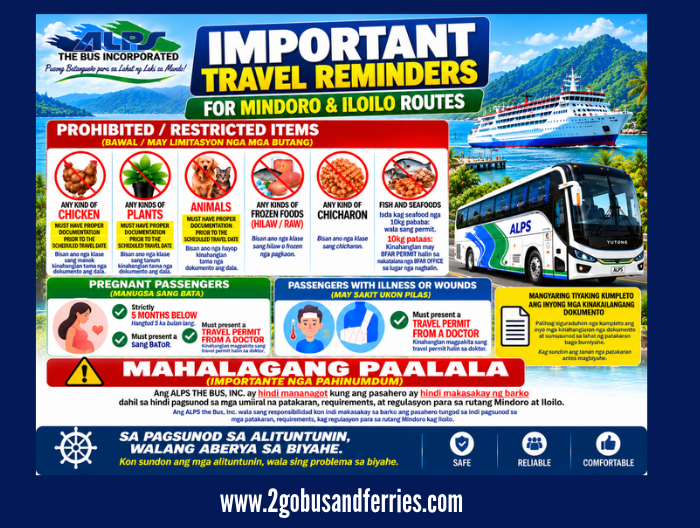
The notice is labeled “Important Travel Reminders for Mindoro & Iloilo Routes.” It focuses on chickens, plants, animals, frozen food, chicharon, fish and seafood, pregnant passengers, and people with illnesses or wounds.
The announcement also reminds travelers to prepare complete documentation and comply with applicable ferry and route regulations. Importantly, the graphic does not provide an origin-to-destination bus timetable, sailing dates, ferry names, fare amounts, travel duration, or terminal departure times.
The requirements may also differ depending on what you are carrying, where you are traveling, and which government agency has jurisdiction.
Restricted and Document-Controlled Items
The advisory groups several items under “Prohibited / Restricted Items.” That combined heading matters: it does not necessarily mean every listed category is banned under every circumstance.
- For chickens, plants, and animals, proper documentation must be obtained before the departure date
- Frozen or raw food and chicharon are presented as restricted items without an exemption procedure
- For fish and seafood, the advisory states that up to 10 kilograms does not require a permit, while quantities exceeding 10 kilograms require a BFAR permit obtained from the nearest BFAR office. Because fisheries rules can depend on species, origin, disease-control measures, and destination, confirm the current rule with BFAR and the transport operators instead of assuming the weight threshold is universally sufficient. A permit may also be necessary for particular regulated species regardless of weight.
Bringing Chickens and Other Poultry
The ALPS notice says that any kind of chicken must have proper documentation before the scheduled travel date. A traveler planning to transport live poultry should contact ALPS THE BUS early and ask which veterinary, quarantine, animal health, and destination-specific documents are accepted.
Never assume that a cage and a ticket are enough. Animal movement rules may be designed to limit disease transmission, so an apparently healthy bird can still be subject to documentary controls.
Ask whether live poultry is accepted on the specific bus and ferry combination, whether advance approval is required, and whether a designated cargo process applies.
Keep original documents and digital copies accessible. If you are bringing poultry for commercial purposes, the applicable requirements may be different from those for a personal trip.
Traveling with Plants or Planting Materials
Plants may seem harmless as souvenirs, but the movement of live plants, cuttings, seedlings, soil, and planting materials can be regulated to prevent the spread of pests and diseases.
The ALPS advisory states that any kind of plant must have proper documentation before travel.
Before purchasing plants to carry to Mindoro or Iloilo, check with the relevant plant quarantine authority and confirm that your chosen bus and shipping operator will accept them.
Avoid wrapping plants in a way that prevents inspection, and do not assume a receipt from a plant shop replaces a quarantine or transport permit.
Requirements may vary by plant species, growing medium, and destination. If a seller promises that no papers are needed, verify that claim independently before you travel.
Traveling with pets and other animals
The notice lists animals and requires proper documentation before the scheduled travel date.
Pet owners should verify both the ALPS bus policy and the ferry operator’s policy, because permission to board one vehicle does not automatically guarantee permission to board the other.
Ask whether dogs or cats must travel in carriers, whether a veterinary health certificate or vaccination record is required, whether pet fees apply, and whether there are limits on animal size or breed.
Do not interpret the image as a blanket promise that all pets are accepted. Make arrangements well ahead of departure, particularly for overnight or long-distance travel.
Bring water, suitable food, cleaning supplies, a secure carrier, and any medication your veterinarian recommends.
Avoid sedating an animal without veterinary guidance. Make sure contact details are attached to the carrier and keep the pet secure during transfers between terminals, buses, and vessels.
Frozen Food, Raw Products, and Chicharon
The advisory specifically names any kinds of frozen foods, described as “hilaw/raw,” and any kind of chicharon among prohibited or restricted items.
It does not describe a permit process or exception for these two categories.
If you plan to bring frozen meat, raw products, cooked food that requires refrigeration, or pork-based snacks, seek a clear answer from ALPS and the shipping operator before purchasing or packing them.
Food movement restrictions can change in response to animal disease controls and local regulations. A sealed package, icebox, or supermarket receipt does not by itself establish that an item may be carried.
Travelers should also think about spoilage during delays, especially on routes involving ferry crossings and extended road travel. When uncertain, leave restricted food behind rather than risk confiscation, disposal, or denied boarding.
Fish and Seafood: Understanding the 10-Kilogram Reminder
The seafood panel states that fish and seafood weighing 10 kilograms or less do not need a permit and that amounts above 10 kilograms require a BFAR permit from the nearest BFAR office.
Treat this as the operator’s stated reminder for the advertised routes, not a complete statement of every fisheries law.
Different fish species, live aquatic animals, protected wildlife, disease-control areas, and commercial shipments may be governed by additional rules.
Travelers transporting seafood should confirm the current BFAR and local requirements and whether the ferry company allows the packaging.
Use secure, leak-resistant containers and follow any temperature-control instructions. Avoid bringing products with strong odors or containers that may leak into passenger luggage areas.
When transporting more than 10 kilograms, arrange documentation before the trip instead of expecting to obtain approval at the terminal.
Pregnant Passengers: Confirm the Exact Medical Clearance Policy
The advisory for pregnant passengers refers to those five months pregnant and says a travel permit from a doctor must be presented.
The wording is unusual and should not be generalized into a rule that all pregnant travelers are eligible or ineligible at particular stages of pregnancy.
The safest interpretation is that the poster calls for medical clearance for the group it identifies, while the full pregnancy policy must be confirmed directly with the ferry operator and ALPS.
If you are pregnant, ask for the current gestational-age limits, whether a medical certificate must be recently issued, and what information it must contain.
Discuss the trip with your healthcare professional, particularly if you have symptoms, complications, or a high-risk pregnancy.
Consider the total journey, not just the sailing: waiting at ports, road conditions, and access to healthcare may all matter.
Passengers with illness, injuries, or wounds
- For passengers with an illness or wounds, the notice says a travel permit from a doctor must be presented.
- If you are recovering from surgery, have a fever, have an infectious illness, or have a recent injury or another condition that may affect your ability to travel safely, contact the operator before departure.
- Ask whether a fit-to-travel certificate is required, whether it needs to identify your condition, and whether the bus or vessel can accommodate your needs.
- A doctor’s approval does not necessarily override a carrier’s safety requirements.
- Pack essential medicines in hand luggage, keep them in original packaging when practical, and carry copies of relevant prescriptions.
- If you need mobility assistance, arrange it in advance rather than waiting until boarding.
- Seek urgent medical advice for serious symptoms instead of attempting a long journey.
Planning Your Mindoro Journey
Mindoro attracts travelers who want beaches, diving, mountain landscapes, and a quieter pace outside Metro Manila.
Puerto Galera in Oriental Mindoro is known for its beaches, snorkeling, and dive sites, while Calapan is a common transport gateway.
Occidental Mindoro offers coastal towns and access to destinations such as Apo Reef Natural Park, although reaching some attractions requires additional road and boat arrangements.
Your exact ALPS route and ferry crossing determine which of these destinations is practical.
Check the port where the bus disembarks, the onward road travel required, and local transport availability.
Travelers carrying pets, plants, or regulated goods should be especially careful with onward transfers, because another boat or local carrier may apply separate restrictions.
What To See Around Iloilo
Iloilo is an appealing destination for heritage, food, and island trips. In Iloilo City, visitors can explore the historic district of Jaro, the Molo Church area, and the Iloilo River Esplanade.
The city is also known for local dishes such as La Paz batchoy and pancit molo.
Travelers with more time may consider heritage towns in the province or a trip toward northern Iloilo for island-hopping destinations such as the Gigantes Islands, subject to local boat schedules and weather.
These plans are only after confirming your arrival terminal and estimated arrival time.
Long-distance bus and ferry journeys can be tiring, so leaving a flexible first day often works better than booking an immediate excursion.
If you are carrying items listed in the ALPS advisory, verify their transport requirements before making any side trips.
Practical Packing Checklist
Start with identification, tickets, booking references, and emergency contact details.
Put permits and medical clearances in a waterproof folder that can be retrieved quickly at inspections. Take photographs or scans of important documents, but ask whether the operator requires physical originals. Pack a refillable water bottle, snacks that comply with transport restrictions, medication, chargers, and a light jacket for air-conditioned buses and ferry cabins.
A small travel pillow and eye mask can make long trips more comfortable. Keep valuables with you and avoid placing critical medicines in checked baggage.
For products requiring temperature control, do not pack them until the operator has confirmed acceptance.
If you are traveling with children, older adults, or passengers who need assistance, agree on meeting points, and make sure everyone understands boarding instructions.
At the Bus Terminal and Ferry Port
Arrive with sufficient time to handle ticket checks, luggage inspection, and any document review.
Follow the specific check-in deadline given for your departure rather than assuming every route uses the same boarding window.
Keep documents within reach, label bags, and be prepared to identify the contents of coolers or boxes. If staff request inspection of plants, animals, or seafood, cooperate and present the relevant papers.
Do not attempt to conceal restricted items inside ordinary luggage. During ferry transfers, follow crew instructions, remain in designated passenger areas, and pay attention to safety announcements.
Weather and operational changes may affect the journey even after the bus has left the terminal.
Share your travel plans with someone you trust, particularly when traveling overnight.
How to Avoid Common Travel Disruptions
The most preventable problems are incomplete permits, incorrect assumptions about what may be transported, and tight connections.
Contact ALPS the BUS at (043) 723 9033 before buying perishable goods or arranging an animal’s transport. Ask for the exact document names and issuing agencies rather than relying on informal advice.
Check the sailing status again close to departure, especially during periods of heavy rain or strong winds. Keep a little flexibility in hotel reservations and onward transportation.
If a restriction is unclear, ask the operator for written clarification. The ALPS reminder explicitly warns that the company is not responsible when a passenger cannot board a vessel because of noncompliance with applicable Mindoro and Iloilo route rules.
That warning is a strong reason to resolve questions before arriving at the port.
Frequently asked questions
Does the advisory show the latest ALPS bus schedule?
- No. It is a travel-requirements notice and contains no departure timetable.
Are pets completely prohibited?
- The advisory is not an unconditional acceptance or a universal ban.
Can I bring plants?
- Only after confirming the applicable documentation and carrier policy.
Is seafood under 10 kilograms always exempt?
- The advisory states a 10-kilogram threshold, but additional fisheries and species-specific controls may apply.
Can I bring chicharon?
- It appears under prohibited or restricted items; obtain current confirmation before carrying it.
Do pregnant travelers need a doctor’s letter?
- The advisory refers to medical travel permission for passengers below five months pregnant; confirm the full policy and discuss individual suitability with a healthcare professional.
What happens if I arrive without the right documents?
- You may be delayed or denied ferry boarding.
Can I rely on a bus ticket for the ferry leg?
- Ask whether your specific ticket includes the crossing and what check-in procedures apply.
Final reminder for travelers
The main message is simple: for ALPS routes involving Mindoro and Iloilo ferry travel, preparation begins before the day of departure.
Check whether your baggage contains restricted goods, secure documents for animals or plants, verify any seafood permits, and arrange medical clearance when required.
Confirm the exact bus and sailing schedules separately, because the travel-reminder poster does not publish them.
This article reflects the supplied ALPS announcement and offers general trip-planning advice; rules and operations may change.
Before traveling, confirm the latest instructions directly with ALPS The Bus at (043) 723 9033, the relevant shipping line, and the responsible government agency.
A few calls before departure can prevent a frustrating interruption at the port and help make your bus-and-ferry journey more comfortable.
IMPORTANT REMINDER
ALPS The Bus, Inc. will not be held responsible if a passenger is unable to board the ferry due to failure to comply with the existing policies, requirements, and regulations for the Mindoro and Iloilo routes.
Please ensure that all your required documents are complete and that you comply with all applicable regulations before traveling.
FOLLOW THE RULES FOR A HASSLE-FREE JOURNEY.
For more practical Philippine bus and ferry guides, follow us on Facebook: 2Go Bus and Ferries.