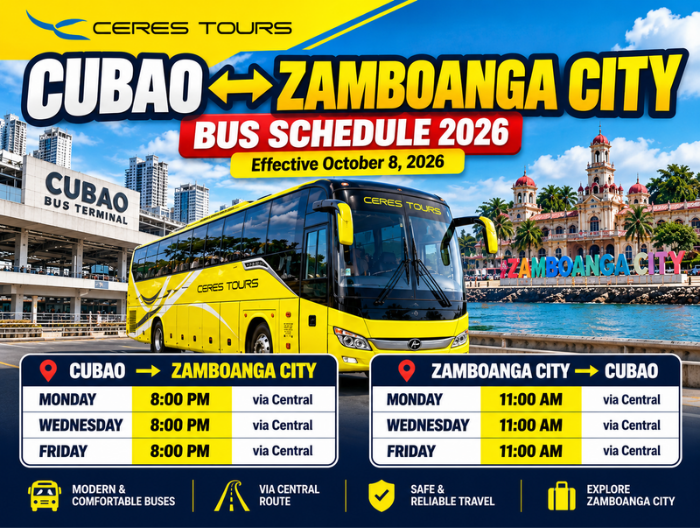
The new Ceres Tours Cubao–Zamboanga City schedule, effective October 8, 2026, provides three scheduled departures per week in each direction, connecting Metro Manila and Zamboanga City via the Central route.
For travellers planning a long-distance journey between Luzon and Mindanao, this guide covers the published departure times, route information, ticketing considerations, ferry connections, and practical tips for a more comfortable trip.
Ceres Tours Cubao to Zamboanga City Bus Trip Schedule
| Monday | 8:00 PM | Via Central |
| Wednesday | 8:00 PM | Via Central |
| Friday | 8:00 PM | Via Central |
Zamboanga City to Cubao Bus Departure Schedule
| Monday | 11:00 AM | Via Central |
| Wednesday | 11:00 AM | Via Central |
| Friday | 11:00 AM | Via Central |
The schedule is particularly useful for travellers who prefer direct, long-distance bus travel rather than arranging several separate transport bookings.
Schedules are subject to change without prior notice.
What does “via Central” mean?
Both directions carry the routing label “via Central.” This label helps distinguish the announced service from other route variants, but the poster does not identify every road, ferry port or stop covered by the journey. It would be misleading to present an exact sequence of towns or ferry crossings without a current operator itinerary. If you intend to board or get off somewhere between Cubao and Zamboanga City, ask the ticket office whether that stop is officially served, whether it is a designated passenger stop and whether your ticket permits it. The same applies to travellers who hope to connect with another bus at an intermediate city. An advertised through service does not automatically mean every location along the way is an authorized boarding point.
Does the bus use a RORO ferry?
Inter-island bus services between Luzon and Mindanao commonly involve roll-on/roll-off ferry transport. A RORO vessel carries road vehicles across a sea passage, allowing a bus to continue its overland journey after disembarkation. Public route descriptions of the Cubao–Zamboanga service mention RORO travel. What has not been established from the dated poster is the exact ferry operator, port sequence, sailing time or whether a passenger must leave the bus during crossings. Ferry procedures can vary. Follow instructions from the bus crew and vessel staff, and keep your identification, medicine, phone and valuables accessible. Do not assume you can access the luggage compartment while the bus is on the vessel. Sea conditions can affect sailing schedules, so keep your arrival plans flexible.
Where should passengers board in Cubao?
The announcement names Cubao as the departure point, but it does not print a street address or bay number. Online Ceres-related terminal listings mention locations in the Cubao/Kamuning area, and booking interfaces may label the terminal differently from a casual description of “Cubao.” That is why your ticket or the operator’s direct instructions should take priority over an address copied from an older blog post. Check the terminal name, entrance, boarding bay and check-in procedure before your travel date. If you are arriving by MRT, taxi or ride-hailing service, share the exact terminal location from your confirmed booking. Allow extra time for luggage handling and any ticket verification at the counter.
Where do passengers arrive in Zamboanga City?
The schedule identifies Zamboanga City as the destination, but it does not specify the exact unloading bay. The Yanson Group booking interface lists a Zamboanga terminal, yet the final arrival point should still be confirmed against your ticket. This matters if family members are picking you up, especially after a long journey when your phone battery may be low. Share your trip details with the person meeting you, and avoid promising an exact arrival time until the bus crew provides a reliable update. If you will need onward transport to another town on the Zamboanga Peninsula, check local connections separately because a through bus timetable does not guarantee onward services will still be operating when you arrive.
How to check fares and book a ticket
The supplied schedule does not state a fare. Ticket prices can vary according to service, date, passenger category and applicable operator rules, so publishing an invented amount would not help travelers. Start by checking the Yanson Group of Bus Companies booking platform, which lists terminal choices including EDSA Kamuning and Zamboanga. Select your intended travel date and review the available trips, but do not assume every announced departure will appear online. If the route is unavailable in the booking system, contact the operator or the relevant ticket office to ask whether counter sales are offered. Before paying, confirm the departure date, terminal, passenger name, luggage allowance, refund or rebooking rules and whether the fare includes any ferry-related charges. Keep a screenshot or copy of your booking confirmation.
Best day to leave: Monday, Wednesday or Friday?
All three outbound days have the same posted 8:00 PM departure, so there is no timetable advantage between Monday, Wednesday and Friday. The better choice depends on your personal plans. Monday may suit someone who wants to start a long journey early in the week. Wednesday can work for travelers with a flexible midweek schedule. Friday may appeal to passengers who can leave after the working week, although holiday and weekend demand may affect ticket availability. Consider your expected arrival day rather than only the day you board. Since this trip crosses islands, do not treat the journey as an ordinary same-day or next-morning commute. If you are traveling with children or older relatives, choosing a departure with a generous arrival buffer may be more important than the specific weekday.
What to pack for a long bus-and-ferry journey
Pack as though you will be away from your main luggage for an extended period.
- A small carry-on bag should hold identification, tickets, prescription medicines, drinking water, light snacks, a power bank, charging cable, tissues, hand sanitizer and a change of clothing.
- A light jacket is useful on air-conditioned buses, while a compact raincoat can help during transfers or terminal stops.
- Bring any personal hygiene items you may need, and keep emergency contacts stored both on your phone and somewhere offline.
- If you are prone to motion sickness, ask a pharmacist or clinician about suitable precautions before departure. Avoid putting medicines, cash or travel documents in checked luggage.
- Label larger bags clearly, and take a photograph of them before handing them over.
Travelling with children, seniors or people with mobility needs
A long route is more manageable when everyone understands what the trip involves. Families with young children may want to pack quiet activities, familiar snacks, wipes and extra clothes. Seniors and passengers with mobility limitations should ask the operator about step height, seat selection, accessible boarding and the procedures during ferry crossings. Do not assume the same assistance is available at every terminal or vessel. If a traveller needs regular medication or meals at specific times, prepare for delays and keep essentials close. For infants, verify any seating and ticketing rules rather than assuming that the arrangements used on a shorter local bus apply to an inter-island coach.
Food, rest stops and comfort on board
Long-distance travel is easier when you expect some waiting. There may be meal breaks or stops, but the dated poster does not identify their locations or durations. Carry enough water and snacks for unexpected delays, while avoiding large quantities of food that spoil easily. Wear comfortable clothes and shoes that are practical for boarding, disembarking and walking through terminals. Stretch safely during permitted stops, and return to the bus promptly when instructed. If you have dietary restrictions, bring food that works for you instead of relying entirely on roadside options. Keep some cash in smaller denominations for minor purchases, although payment arrangements may vary by stop.
What to do when you reach Zamboanga City
Zamboanga City has plenty to offer visitors beyond being the end of a bus route.
Travellers can explore the historic Fort Pilar area, discover local food traditions and look for opportunities to experience the city’s distinctive culture.
Paseo del Mar is a familiar waterfront destination, while Santa Cruz Island is known for its remarkable pink-hued sand; island visits require separate arrangements and are subject to local rules and weather.
If you want to visit these places after arriving by bus, give yourself time to rest first. A lengthy inter-island journey can be tiring even when the bus is comfortable.
Check current opening hours, tour permits and transport arrangements before setting out. These attractions are suggestions for a separate itinerary, not stops included in the Ceres service.
Is taking the bus better than flying?
There is no single answer for every traveler. Flying will usually be more appealing when speed is the main priority, particularly if you have limited leave from work or a fixed appointment. A bus journey may suit passengers who prefer overland travel, want to avoid airport arrangements or are comparing different travel budgets.
But do not compare only the headline ticket prices. Consider the total cost of food, ground transfers, baggage and the time you will spend in transit. For a long bus-and-ferry trip, uncertainty around ferry crossings also deserves attention.
If you value predictable arrival time more than the journey itself, compare available flights and confirmed bus details before deciding.
Common Booking Mistakes to Avoid
One easy mistake is reading the return departure time as the outbound time. The Cubao trip leaves at 8:00 PM on the announced days, while the Zamboanga City return leaves at 11:00 AM. Another mistake is assuming the route runs daily because a promotional graphic says “daily schedules of trips.” The specific table lists only Monday, Wednesday and Friday for this service. A third mistake is treating an estimated travel duration as a guaranteed arrival time. Finally, do not assume that “via Central” permits you to board at every town along the way. Confirm all of these details before paying or arranging a pickup. Save the announcement for reference, but prioritise any later operator advisory that explicitly supersedes it.
Frequently asked questions
Does Ceres Tours travel from Cubao to Zamboanga City every day?
- Not according to the October 8, 2026 poster. It lists Monday, Wednesday and Friday.
What time does the bus leave Cubao?
- The posted departure is 8:00 PM on each listed day.
What time is the Zamboanga City to Cubao return trip?
- The supplied announcement states 11:00 AM on Monday, Wednesday and Friday.
Does the bus travel via Central?
- Yes, both directions are labelled “via Central.”
How much is the fare?
- No fare is printed on the poster; confirm the current price with the booking service or operator.
Is the journey entirely by road?
- Public route descriptions indicate RORO ferry travel as part of the inter-island journey.
Are the departure times guaranteed?
- No. Schedules are subject to change without prior notice.
Final travel reminder
The most useful takeaway is simple: match the departure day, departure city and departure time before making plans. Cubao to Zamboanga City is listed for Monday, Wednesday and Friday at 8:00 PM. Zamboanga City to Cubao is listed for the same days at 11:00 AM.
Both are marked via Central, effective October 8, 2026. The announcement is valuable for planning, but it leaves some important questions unanswered.
Confirm fares, exact terminals, ticket availability, the route and the latest operating status directly before setting off.
For more practical Philippine bus and ferry guides, follow us on Facebook: 2Go Bus and Ferries.
Safe travels, and ingat sa biyahe!