What Travelers Should Know Before Boarding: Understanding the Announcement
A bus ticket is more than proof of payment. It also comes with conditions covering boarding, reservations, luggage, conduct, and what happens when plans change.
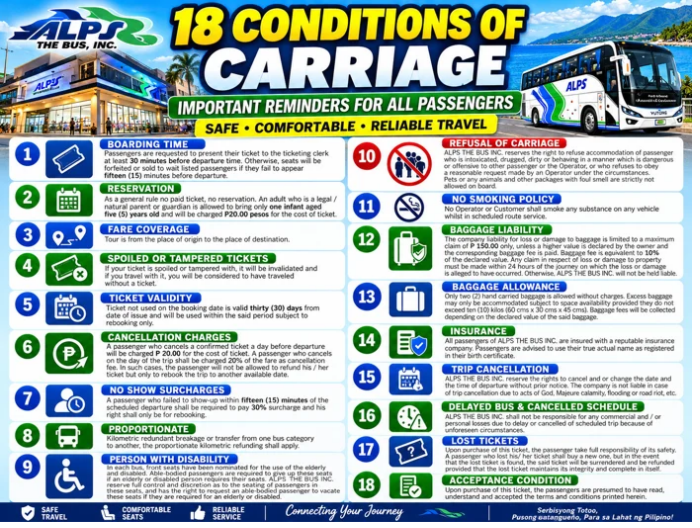
ALPS The Bus has published an 18-point conditions-of-carriage poster.
The guide below explains those points in plain language while preserving the figures printed on the notice.
Treat this guide as the source for the operator’s advertised policy, not as a substitute for applicable consumer law or a guarantee that every condition will be enforced in all circumstances.
1. Boarding Time: Arrive Early
The announcement asks passengers to present their tickets to the ticketing clerk at least 30 minutes before departure.
It warns that a seat may be forfeited or offered to a waiting passenger if the ticket holder has not appeared 15 minutes before departure.
For a smooth trip, aim to reach the terminal substantially earlier than the minimum, particularly on holidays and routes that involve ferry crossings.
Allow time for finding the correct bay, checking luggage, and confirming the vehicle.
2. Reservations and Infant Tickets
The advisory states a general rule of “no paid ticket, no reservation.”
It also says an adult parent or guardian may bring one infant aged five years old, subject to a ₱20 ticket charge.
Because the wording is unusual for the age range, confirm the exact child eligibility and seating arrangements directly with the operator before buying.
If a child requires a separate seat, do not assume the small infant charge applies.
3. Fare Coverage and Your Destination
The fare is described as covering travel from the stated origin to the stated destination.
Check both locations before completing payment. A terminal name that sounds similar to another stop can still refer to a different boarding point.
If your trip combines a bus ride and a RoRo ferry segment, ask whether any terminal fee or other charge is included in your ticket.
4. Spoiled or Tampered Tickets
According to the ALPS advisory, tickets that have been spoiled or tampered with are invalidated.
Protect paper tickets from water and tearing.
For digital confirmations, keep an offline screenshot of the booking details but follow the operator’s instructions about what form of ticket is acceptable.
If a ticket becomes unreadable, contact the counter immediately rather than attempting to alter or repair it yourself.
5. Ticket Validity and Rebooking
The notice states that an unused ticket is valid for 30 days from issue, subject to rebooking within that period. That does not mean a passenger can simply arrive for a different departure and board without coordination. Ask about available seats, any fare difference, and the exact rebooking process. Keep a record of the date of purchase and any written confirmation of your revised journey.
6. Cancellation Charges
The advisory states a ₱20 cancellation charge for a confirmed ticket canceled one day before departure.
For cancellation on the day of travel, it lists a charge of 20% of the fare and says a refund is not permitted, with rebooking offered instead.
7. No-show Surcharge
Passengers who fail to appear within 15 minutes of the scheduled departure are subject to a 30% surcharge and rebooking only.
Avoid treating this as a grace period: the separate boarding provision asks travelers to report earlier.
Traffic, queues, and wrong-terminal arrivals can all turn into a missed departure, so check your route to the terminal the night before.
8. Proportionate Refunds
The ALPS advisory mentions proportionate kilometer-based refunds in the event of redundant breakage or transfer from one bus category to another. The wording is not fully clear.
If a vehicle issue changes the service delivered, document the route segment already traveled and ask staff to explain any refund calculation.
Keep the ticket and receipts until the matter is resolved.
9. Seats for Persons with Disabilities and Older Passengers
Front seats are designated in the notice for older passengers and passengers with disabilities.
Other able-bodied travelers are asked to yield those seats when needed.
If you require accessible boarding assistance, contact the terminal ahead of time and identify the type of help you need.
Ask whether the assigned vehicle has suitable steps, handrails, or other access features; accessibility can vary by bus.
10. Refusal of Carriage
The advisory states that ALPS may refuse carriage to intoxicated passengers or those acting dangerously or offensively, and it prohibits pets, other animals, and packages with strong odors.
Travelers should behave respectfully toward staff and fellow passengers.
If you plan to bring an animal or unusual cargo, obtain explicit confirmation before traveling. Requirements can differ across land transport and ferry operators.
11. No-Smoking Policy
The announcement prohibits smoking any substance inside a vehicle during scheduled service.
This protects other passengers and helps keep the cabin comfortable.
Do not assume vaping is allowed merely because it produces no conventional cigarette smoke.
Follow posted terminal restrictions as well as onboard rules.
12. Baggage Liability
The notice states a default maximum baggage claim of ₱150 unless a higher value is declared and corresponding baggage fees are paid, described as 10% of the declared value.
It also asks that claims be made within 24 hours of the journey in which the loss or damage allegedly occurred. These are the operator’s printed terms, not a legal determination of the limits of passenger rights. Photograph damaged baggage, report it promptly, and retain documentation.
13. Baggage Allowance
ALPS the Bus permits two pieces of hand-carried baggage without additional charge. It says excess baggage may be accepted if space is available and references a 10-kilogram limit and dimensions of 60 × 30 × 45 centimeters. Because the exact application of the weight and dimension wording is unclear, ask whether those limits apply per item or in total. Oversized bags should be discussed with the ticket office before departure.
14. Passenger Insurance
The notice says passengers are insured through an insurance company and encourages use of the passenger’s actual name as shown on their birth certificate. Always provide accurate personal details on tickets. For a specific coverage amount, claims process, or eligibility question, request the current policy information from the operator. Insurance is not a reason to neglect safe travel habits.
15. Trip Cancellation and Changes
ALPS Bus may change the departure date or time or cancel a trip without prior notice and cite events such as flooding, calamities, and road disturbances.
Weather and port restrictions can especially affect journeys involving ferries. Recheck the trip close to departure and have a flexible onward itinerary.
For cancellations, ask about available rebooking or refund options and preserve written communications.
16. Delayed Buses and Cancelled Schedules
The operator’s notice disclaims liability for commercial or personal losses caused by delays or cancelled trips arising from unforeseen circumstances.
Avoid scheduling a flight or other nonrefundable connection immediately after a long bus journey. Build a buffer into the itinerary, especially when ferries, heavy rain, or traffic may affect the route.
Statutory passenger rights may still apply regardless of how a notice is phrased.
17. Lost Tickets
The announcement puts responsibility for ticket safekeeping on the passenger and instructs someone who loses a ticket to purchase a new one. It also says the original may be refunded if later found and returned complete and intact. If you misplace your ticket, contact the counter with your booking details and proof of payment before purchasing another. Ask for written confirmation of any replacement and refund conditions.
18. Acceptance of Conditions
The final provision says buying a ticket indicates that the passenger has read, understood, and accepted the printed conditions. Travelers should review terms before paying, especially for a family booking or a trip with multiple connections. Keep a copy of the conditions that applied when the ticket was purchased, because posters and booking pages may change over time.
Bus and Ferry Sailing Timetable: What Is Confirmed?
This specific ALPS poster contains no origin-by-origin bus departure table and no ferry sailing times. It would be misleading to attach a “complete sailing timetable” to it.
For Mindoro or Iloilo travel, first verify your exact ALPS departure and terminal, then confirm any ferry segment with the relevant shipping company or the operator handling the through-ticket.
Ask whether the listed bus departure is the start of the entire through-journey or only one leg.
How To Prepare For A Bus-and-Ferry Journey
Begin by checking the correct terminal, route, and ticket details. Bring a valid identification document, enough cash for incidental expenses, and a charged phone. Keep medicines, valuables, and travel papers in a small bag that remains with you. Carry drinking water and a light jacket for air-conditioned travel. If your route involves a ferry, follow port security instructions and be ready for schedule changes caused by weather or operational conditions.
Mindoro Attractions
Travelers visiting Oriental Mindoro often look toward Puerto Galera for beaches, snorkeling, and coastal scenery.
Calapan serves as a useful urban gateway for transport and local food stops.
In Occidental Mindoro, Apo Reef is a celebrated marine destination, but access depends on boat operators, permits, and weather.
These are travel ideas, not a claim that every ALPS bus stops at each attraction.
Plan onward transfers separately.
Iloilo Attractions to Consider
In Iloilo City, visitors can explore the Iloilo River Esplanade, heritage districts, local markets, and the well-known food scene.
A day trip toward Miagao can include the UNESCO-listed Miagao Church, while farther excursions may feature coastal communities and Guimaras via a separate boat connection.
Check local opening hours, ferry schedules, and travel time before combining attractions in one day.
Frequently Asked Questions
How early should I arrive?
- The poster asks passengers to present their tickets at least 30 minutes before departure; arriving earlier is prudent.
Can I change an unused ticket?
- The notice mentions a 30-day validity period subject to rebooking.
Are pets allowed?
- The conditions poster says pets and other animals are not allowed on board.
What if my bus is delayed?
- Contact ALPS at (043) 723 9033 for the latest departure information and ask about your options.
Final Travel Reminder
The simplest way to avoid a difficult travel day is to check your booking, arrive ahead of time, pack within the stated allowance, and keep all documents accessible.
The 18 conditions provide a useful overview, but questions about specific charges, insurance, passenger rights, and special needs deserve direct confirmation with ALPS.
For bus-and-ferry journeys, always check the current sailing status separately before leaving home.
For more practical Philippine bus and ferry guides, follow us on Facebook: 2Go Bus and Ferries.