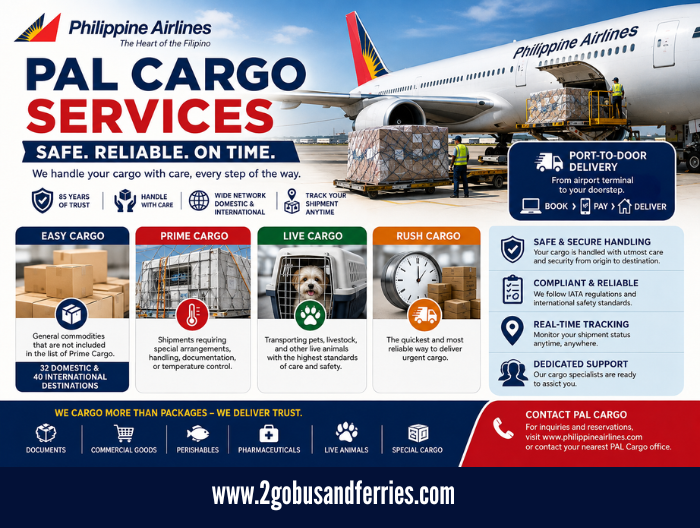
Sending packages, important documents, commercial goods, pets, perishables, or time-sensitive shipments by air can be one of the quickest ways to move cargo across the Philippines or overseas. For travelers, businesses, online sellers, and families seeking an air-freight option, PAL Cargo Services offers several solutions for different types of shipments.
Philippine Airlines describes cargo handling as part of its long-standing commitment to caring for shipments. Its cargo services cover ordinary commodities and also shipments requiring special arrangements, documentation, temperature control, or faster handling.
Based on the PAL Cargo information provided, customers can choose among services such as Easy Cargo, Prime Cargo, Live Cargo, Rush Cargo, and Port-to-Door Service. Each option serves a different shipping requirement, so knowing which service fits your cargo can help you prepare the correct packaging and documents before proceeding to the cargo terminal.
This guide explains the available PAL Cargo options, important packing requirements, special-cargo considerations, live-animal requirements, Rush Cargo reservations, and how PAL’s Port-to-Door service works.
Important: Cargo acceptance, schedules, documentation, restrictions, available destinations, and other requirements may change. Always confirm the latest requirements with Philippine Airlines before bringing your shipment to the cargo terminal.
What Is PAL Cargo?
PAL Cargo is the air-cargo service associated with Philippine Airlines (PAL). Rather than limiting its services to ordinary boxes and parcels, PAL Cargo accommodates several categories of cargo depending on the nature and urgency of the shipment.
The supplied PAL Cargo material divides the services into several categories. Easy Cargo is intended for general commodities that are not included under Prime Cargo, while Prime Cargo covers shipments that may require special arrangements, handling, documentation, or temperature control. Separate services are also provided for live animals and urgent shipments.
For customers who need delivery beyond the airport cargo terminal, PAL also provides a Port-to-Door option in selected areas.
This range makes PAL Cargo potentially useful for individual senders as well as businesses moving merchandise, supplies, temperature-sensitive products, and other cargo.
PAL Easy Cargo
For ordinary shipments, Easy Cargo is one of the most straightforward PAL Cargo options.
According to the PAL Cargo information on page 1 of the supplied material, Easy Cargo covers general commodities that are not included in the list of Prime Cargo. It also states that the service can handle goods for 32 domestic and 40 international destinations, covering both small parcels and larger shipments.
Easy Cargo Packing Guidelines
PAL highlights three basic considerations when preparing an Easy Cargo shipment.
First, items must be properly packed so that they can withstand normal handling and transportation.
Second, customers should use protective packaging. The packaging should protect the cargo itself while also preventing the shipment from damaging other cargo, aircraft, or cargo-handling equipment.
Third, PAL indicates that customers can track their shipments through its PAL Cargo Tracking system.
Good packaging is particularly important with air freight because shipments can pass through several handling points between cargo acceptance and final release.
Before going to the airport, make sure your package is securely closed, appropriately cushioned, correctly labeled, and suitable for the contents inside.
PAL Prime Cargo
Not every shipment can be handled as ordinary cargo.
Prime Cargo is intended for cargo requiring special arrangements. According to the PAL information provided, this may include shipments needing specialized handling, documentation, or temperature control.
Examples covered in PAL’s cargo FAQs include dangerous goods, perishables, human remains, pharmaceuticals and medical supplies, and firearms. Each category has additional requirements.
Because requirements vary significantly by cargo type, customers shipping special commodities should verify the applicable rules before packing or transporting the shipment to the airport.
Dangerous Goods and Battery-Powered Equipment
Air transport of dangerous goods is strictly regulated because incorrectly declared or packaged items can create serious safety risks.
The PAL Cargo FAQ specifically identifies examples such as the following:
- Lithium-ion and lithium-metal batteries
- Power banks and spare batteries
- Electronic devices containing batteries
- Aerosols
- Flammable liquids
- Chemicals
- Compressed gases
PAL warns that improper declaration, packing, or handling can pose risks to the aircraft, passengers, and crew. The material also strongly advises passengers not to transport dangerous goods as personal baggage when the items are intended for commercial shipment.
For commercial dangerous-goods shipments, accredited freight forwarders or cargo-handling companies may be necessary.
These entities are expected to properly classify and declare the goods, ensure compliant packaging and labeling, and prepare required documentation such as a Material Safety Data Sheet (MSDS) when applicable.
Because dangerous-goods rules can depend on the exact substance, quantity, packaging, battery configuration, and route, do not assume that an item is acceptable simply because similar items have previously been transported.
Shipping Perishable Goods with PAL Cargo
Fresh produce, seafood, plants, and similar products need additional preparation because they may deteriorate during transportation.
According to PAL’s FAQ, quarantine permits from relevant agencies—including NMIS, BPI, or BFAR, depending on the cargo—may be required. Proper packaging is also essential to preserve freshness and prevent spoilage during transit.
PAL’s supplied information identifies several common packing materials for perishables, including expanded polystyrene cartons, plastic containers and polyethylene bags, waxed cardboard or fiberboard cartons, wooden barrels, crates, boxes and kegs, metal cans, Styrofoam insulation, and moisture-absorbent materials.
The appropriate material depends on what is being shipped.
Seafood, for example, may have very different containment and temperature requirements from fruit, vegetables, or plants. Customers should therefore confirm both the airline’s requirements and any government permits applicable to their commodity.
Pharmaceuticals and Medical Supplies
Medical cargo can require particularly careful handling.
PAL states that health and government permits may be required depending on the product. Pharmaceuticals should also be packed so that their condition can be maintained throughout transportation, taking factors such as temperature, humidity, altitude, and orientation into account.
For time- and temperature-sensitive healthcare products, PAL’s material refers to compliance with applicable IATA Temperature Control Regulations (TCR).
Packaging should protect the shipment from environmental changes that may occur during flight and during ground handling at the origin, transit points, and destination.
This makes advance coordination particularly important for medical cargo rather than simply arriving at the airport with a prepared package.
Human Remains Transportation
PAL Cargo’s information also outlines requirements for transporting human remains.
For domestic flights, the supplied FAQ lists documents such as a Death Certificate, an Embalming or Cremation Certificate, a Transfer Permit, and a Quarantine Certificate from the Department of Health (DOH). It further states that the coffin must be enclosed in a wooden crate for secure transportation.
International transportation may require additional documents depending on the destination. The PAL material lists standard export requirements that can include an Export Declaration, Consular Mortuary Certificate, Death Certificate, Fumigation Certificate, and Embalming or Cremation Certificate.
PAL also specifies packing requirements, including an outer protective crate and sufficient rigidity and padding to protect the contents and conceal their nature. International transport may require human remains to be contained in a hermetically sealed wooden or metal casket.
Because documentation can differ by destination, customers arranging this type of shipment should coordinate directly with PAL Cargo and the relevant government agencies.
PAL Live Cargo: Transporting Pets and Other Animals
Pet owners relocating or traveling between islands may need a dedicated animal-transport solution rather than conventional baggage.
PAL’s Live Cargo service is intended for pets, livestock, and other live animals. The airline states that live-animal shipments must comply with IATA Live Animals Regulations (LAR) and PAL’s own supplementary regulations.
Important Live Animal Requirements
Several factors affect whether an animal can be transported.
Acceptance standards apply to documentation, labeling, marking, handling, and other shipment requirements.
Temperature variations must also be considered because aircraft cargo holds can experience temperature changes. PAL Cargo therefore cannot guarantee a specific temperature throughout the entire journey.
The animal’s health and condition are another consideration. PAL’s material states that only healthy animals fit for travel will be accepted. It also says the shipper must declare if the animal is pregnant or has given birth within the last 48 hours.
Pet owners should therefore avoid leaving arrangements until the day of departure. Appropriate crates, veterinary documents, permits, acceptance rules, and flight availability should all be checked beforehand.
PAL Rush Cargo for Urgent Shipments
When delivery speed matters, PAL offers Rush Cargo, formally described in the supplied material as Rapid Handling of Urgent Shipment.
The service is positioned as a priority cargo option for shipments that need to reach their destination as quickly and efficiently as possible, subject to availability and operational conditions.
Rush Cargo Advance Reservations
PAL’s information provides useful reservation guidance based on shipment weight.
For shipments of 50 kilos or less, reservations are automatically confirmed when booked at least six hours before the scheduled departure, according to the supplied material.
For shipments above 50 kilos, acceptance is subject to space availability confirmation.
For Manila-only shipments with minimum weight charges, PAL states that no reservation is needed if the cargo is accepted at least two hours before departure.
Volume shipments remain subject to aircraft door-size limitations.
These conditions make it important to plan urgent shipments carefully. “Rush” does not mean that any shipment can automatically be placed on the next aircraft; space, aircraft limitations, acceptance deadlines, and cargo requirements still apply.
PAL Port-to-Door Service
One inconvenience of conventional air cargo is that the consignee may need to travel to an airport cargo facility to collect the shipment.
PAL’s Port-to-Door Service addresses this by delivering eligible cargo from the airport terminal directly to the recipient’s doorstep.
Page 4 of the supplied PAL Cargo material presents the process in four main stages.
Step 1: Confirm Your Booking
Once the cargo reaches the PAL Cargo Terminal, the customer receives an email notification regarding Port-to-Door service availability.
The recipient can then click the booking link contained in the email to confirm the service.
Step 2: Provide Pick-Up Details
The customer supplies the recipient’s information, delivery address, and other required booking details.
PAL emphasizes that the address details should be accurate so the cargo can be delivered to the correct location.
Step 3: Pay the Delivery Fee
Customers can select an available partner courier and pay online using the listed payment options, including GCash, Maya, or GrabPay, according to the supplied material.
Step 4: Receive the Cargo
After payment is processed, the customer waits for the rider to confirm the booking. The cargo is then collected and transported to the recipient’s doorstep.
Why Consider PAL Port-to-Door?
The material supplied by PAL highlights several advantages of this service.
One is convenience: customers do not necessarily have to make another trip to the cargo terminal after their shipment arrives.
PAL also describes the offering as an airport-to-customer air-cargo delivery service, supported by logistics providers for the last stage of delivery.
The service is promoted as offering same-day delivery in selected cities. The locations shown in the supplied material include Manila, Iloilo, Cebu, Davao, Bacolod, and Cagayan. Availability should still be confirmed for a particular shipment and address.
Tracking is another advantage highlighted by PAL, with customers able to receive transaction and delivery updates through email.
How to Prepare Your PAL Cargo Shipment
Preparation can make cargo acceptance much smoother.
Before heading to a PAL Cargo facility, first identify the exact type of commodity you’re sending. Determine whether it qualifies as ordinary easy cargo or whether it falls under a category requiring special handling.
Next, use packaging appropriate to the contents. A sturdy box may be sufficient for ordinary goods, while perishables, pharmaceuticals, live animals, dangerous goods, and other special cargo can require highly specific containers.
Prepare your supporting documentation ahead of time. Government permits, quarantine documents, certificates, declarations, veterinary papers, and other requirements can vary depending on the commodity and destination.
Finally, allow enough time for cargo acceptance and processing. This becomes especially important for urgent cargo, special commodities, and shipments requiring inspection or documentation checks.
Frequently Asked Questions About PAL Cargo Services
What is the difference between Easy Cargo and Prime Cargo?
- Easy Cargo is intended for general commodities not classified under Prime Cargo. Prime Cargo is designed for shipments that require special arrangements, handling, documentation, or temperature control.
Can PAL Cargo transport pets?
- Yes. PAL Cargo provides a live cargo service for pets, livestock, and other live animals. Acceptance is subject to applicable IATA regulations, PAL requirements, documentation, animal health, and other transport conditions.
Can I send batteries through PAL Cargo?
- Some batteries and battery-powered equipment are classified or regulated as dangerous goods. They must be properly declared, classified, packed, labeled, and documented according to applicable requirements.
Does PAL Cargo accept seafood and fresh produce?
- PAL’s cargo information covers perishables such as fresh produce, seafood, and plants. Depending on the commodity, permits from agencies such as NMIS, BPI, or BFAR may be required, together with appropriate protective packaging.
Does PAL Cargo deliver to homes?
- PAL provides a Port-to-Door option for eligible shipments in supported areas. Customers receive notification when the service is available and can provide delivery details, choose an available courier, pay the applicable fee, and have the shipment delivered.
Is there a faster PAL Cargo option?
- Yes. Rush Cargo is designed for urgent shipments. Acceptance and confirmation still depend on factors including shipment weight, reservation timing, available cargo space, and aircraft limitations.
Tips Before Shipping with PAL Cargo
Before sending anything, verify the latest acceptance requirements directly with PAL Cargo, particularly for special or regulated commodities. Don’t assume that passenger baggage rules and cargo-shipping rules are identical.
Pack the shipment for handling rather than simply for storage. Use sufficient cushioning and a strong outer container, and ensure that liquids, perishables, fragile goods, and other sensitive commodities have suitable protection.
For shipments involving permits or certificates, prepare the documents before arriving at the airport. Missing documentation can result in delays or non-acceptance.
For urgent shipments, make reservations early enough to comply with Rush Cargo requirements. For pets or other live animals, coordinate even earlier because documentation, crate specifications, health requirements, weather, and flight conditions may affect acceptance.
Final Thoughts
PAL Cargo Services provide several air-freight options for customers with very different transportation needs. Easy Cargo caters to ordinary commodities, while Prime Cargo covers goods needing specialized handling or documentation. Live Cargo provides a dedicated option for animals, Rush Cargo addresses urgent shipments, and Port-to-Door can extend delivery beyond the airport terminal to the recipient’s address.
The most important part of air cargo shipping is preparation. Correctly identify your commodity, use appropriate packaging, secure the necessary permits, observe cargo acceptance deadlines, and confirm current airline requirements before traveling to the terminal.
For specialized shipments—particularly dangerous goods, perishables, medical products, human remains, or live animals—advance coordination is especially important because additional documentation and packing standards may apply.
With the right preparation, PAL Cargo can provide a practical option for moving parcels, commercial goods, specialized cargo, and urgent shipments by air across its available network. The attached PAL Cargo reference provides the service descriptions and requirements summarized throughout this guide.
Want to receive more updates on airline cargo services, ferry schedules, bus routes, fares, and travel information in the Philippines? Follow us on Facebook: 2Go Bus and Ferries for the latest transportation guides, schedule updates, and travel tips.